

Tree Decay Detection
Our specialist tree decay detection services utilise advanced diagnostic technology to provide a "CT scan" for your trees, allowing for data-driven decisions that balance tree risk management with preservation.
Whether you are managing a high-risk public space or a cherished heritage oak, our non-invasive assessments provide the clarity needed to mitigate risk without unnecessary felling.
Why Choose Arb Innovators for Your BS5837 Survey?
Advanced Diagnostic Technology: We utilise industry-leading PiCUS 3 Sonic Tomograph to provide accurate, non-invasive internal decay mapping.
Expert Data Interpretation: Our qualified arborists possess the technical expertise to interpret the internal decay data.
Evidence-Based Preservation: Our goal is to save trees, not just fell them. We frequently help clients avoid the unnecessary tree felling while simultaneously satisfying legal "Duty of Care" and insurance requirements.


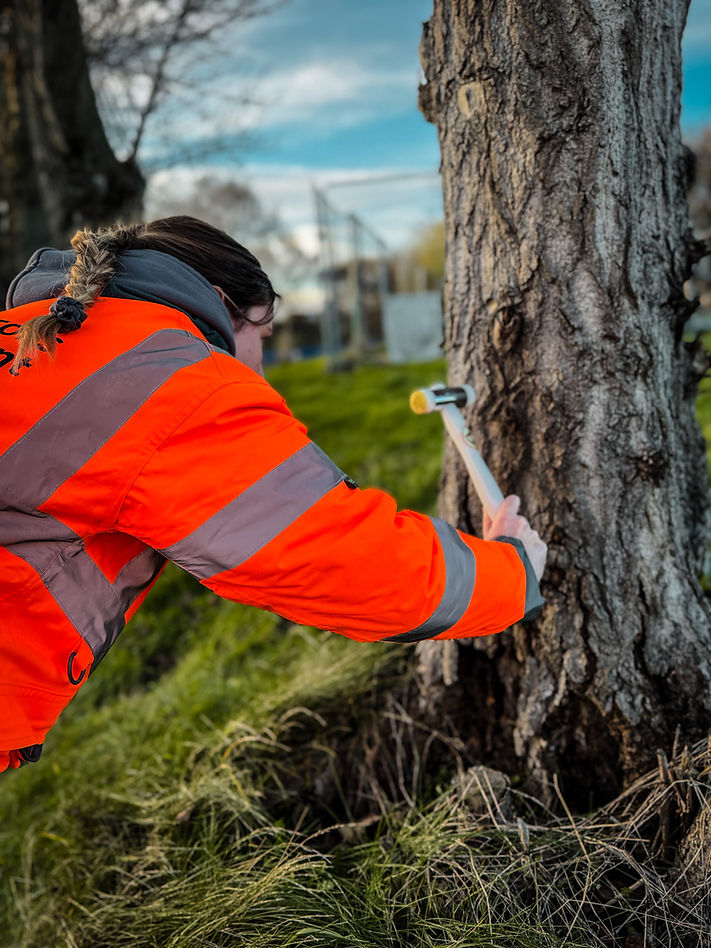
Sonic Tomography: Using PiCUS technology
We utilise the PiCUS 3 Sonic Tomograph, the industry gold standard for non-invasive internal imaging. This technology works on the principle that sound waves travel through solid wood faster than through decayed or hollowed sections.
By placing a series of high-sensitivity sensors around the circumference of the trunk, we measure the "time-of-flight" of sonic impulses. The software then translates this data into a tomogram, a high-resolution, color-coded cross-sectional map of the tree's internal structure.
These dark tones represent areas of high structural density where sonic impulses travel at maximum velocity. When a tomogram is dominated by these colors, it indicates a significant presence of healthy, sound, and lignified wood. This data provides the primary evidence of the tree’s load-bearing capacity, providing greater confidence in its ability to withstand external stresses such as high winds.
Indicated by greens
The green zones on a tomogram signal a "transition zone", the early stages of wood degradation where the wood’s internal density has been altered. While the wood in these areas may still retain some structural value, they represent the tree’s early warning system. Identifying incipient decay is crucial for proactive management.
Highlighted in blue and violet
These cooler tones represent areas of very low-velocity sonic readings, indicating where the wood is significantly compromised, decomposed, or entirely absent. Blue and violet sections identify where structural integrity is at its lowest. Our specialists focus on these areas, ensuring we can accurately determine if the tree poses an unacceptable risk.
Get a free quote
Three steps to get a quote - that's it. We like to keep it simple.
We’ll send you a free, comprehensive and competitive quote outlining everything you need to know.
Simply fill out our quick and easy online form, or email or call us to discuss your project and we'll send you a free quote within 48 hours of your request.
ACCEPT OUR QUOTE ONLINE
Accept our quote using our online booking form and we'll schedule a date for your decay assessment.
GET YOUR SURVEY OR REPORT, PROMPT!
We'll come to your property or site, complete our tree survey and you'll get your comprehensive yet concise tree report, promptly!

Why non-invasive tree testing saves money and trees
Investing in advanced diagnostics is a proactive strategy:
-
Avoid Unnecessary Felling: Many trees marked for removal based on visual assessments are often found to have sufficient sound wood to be retained with an acceptable level of risk.
-
Targeted Pruning vs. Removal: By mapping the extent of decay, we can recommend specific pruning or tree management instead of total removal.
-
For commercial land managers and homeowners, a Sonic Tomography report provides a robust legal "paper trail," proving that you have met your Duty of Care under the Occupiers' Liability Act.
What to expect during a Sonic Tomography assessment
A sonic tomography assessment is efficient and does not affect the tree’s biological health. The process typically follows these steps:
-
Sensor Placement: We tap small, small diameter pins or nails through the bark layer to contact the wood. These act as the interface for the sonic sensors.
-
Geometry Measurement: Using electronic calipers or GPS-based positioning, we map the exact shape of the tree's cross-section.
-
Data Collection: Each sensor is manually tapped, sending sound waves to every other sensor. The data is transmitted via Bluetooth to our field computer for real-time analysis.
-
On-site Verification: If the tomogram identifies a specific area of concern, we may perform a secondary internal assessment using an IML Resistograph to confirm the wood's density.

Invasive Decay Detection: IML Resistograph
While tomography gives us a horizontal "slice" of the tree, the IML Resistograph provides a precision vertical reading. This tool uses a 3mm micro-drill that measures the drilling resistance (torque) as it enters the wood. The Resistograph is "minimally invasive".
We use this specifically to:
-
Confirm the exact depth of a cavity identified by the PiCUS tomogram.
-
Examine the integrity of the root flare and buttress roots where sensors may be harder to place.
-
Identify the transition between early-stage fungal decay and sound lignified wood.
What you get with an Arb Innovators decay detection report
At Arb Innovators, we're not just conducting tree surveys; we're redefining them. Our pioneering approach integrates photogrammetry to bring you accuracy and insights that were once beyond reach.
Our reports are designed to be "citation-ready" for local authorities, insurers, and mortgage lenders. Every assessment includes:
Clear, color-coded images of the internal wood structure and annotated, 3D models of the trees structure, 3D visualisations of sensor positions, and test results.
A detailed breakdown of the results of the survey and assessment, along with an understanding of safety factors.
Clear "Next Steps", whether that is "Retain and Monitor," "Targeted Pruning," or "Removal."
Click the play button or the Sketchfab icon to view the interactive 3D model.
An Advanced Assessment using an IML-RESI PD 400 was conducted 25 July 2024 to establish the extent of decay and presence of a cavity within the main stem of a late mature oak tree at Drayton Manor Theme Park.
Resistance drill tests were carried out from 30cm above ground on the main compass aspects (north, east, south, west) at various heights, up to 220cm at the highest points.
The 3D model demonstrates 10 of 15 drills which were undertaken at various heights at four cardinal points (north, east, south and west) and has been produced to help visualise the location of each test, and the results.
For the purpose of this visualisation, the 3D model shows only drill points for the north, south and west sides of the stem.
HEAR WHAT OUR CLIENTS THINK
Why choose Arb Innovators?
After 15 years in the arboriculture sector our tree consultants have developed the experience needed to carry out a range of surveys and digital solutions tailored to your needs.
But we won't stop there. Arb Innovators was created with a single objective in mind: to enhance arboricultural consulting.
We have already assisted numerous outstanding clients since 2023. Those who have put their trust in us to provide innovative tree surveys, pragmatic Arboricultural advice and consultancy.

Your questions, answered.
Our mission is to help you understand our tree surveys and and reports. Whilst we don't want you to get hung up on the details (that's our job) we feel arming you with knowledge helps reduce anxiety throughout the process.